(04) 551 2125
Mon-Sat 9:00 am-5:00 pm
sales@emcglobaltrade.com
Customer Support 24/7

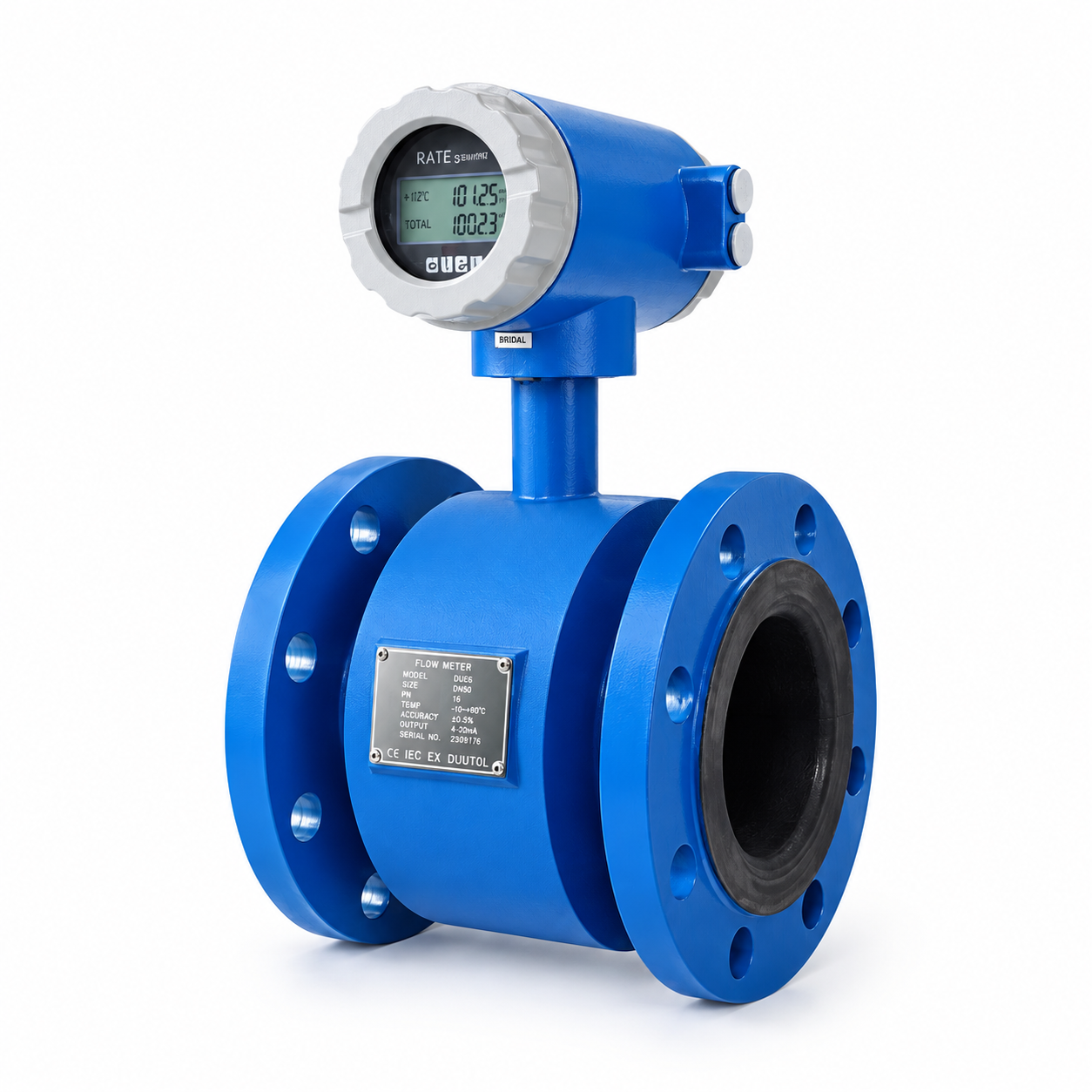


ELECTROMAGNETIC FLOW METER
Specifications
Mechanical Data:
- Materials: Electrode: 316L (Stainless Steel), Hastelloy, Titanium, Tantalum, etc. Liner: PTFE, Soft Rubber, Hard Rubber. Measuring tube: SUS 304 Body & Flange: Carbon Steel. Ground Ring: 316L (stainless steel), HC, Ti, Ta, Cu.
- Connection of Flange: National Standard GB9119-88 (DIN2051, BS4504), JIS, ANSI. Screw. Insertion type, Tri-clamp for sanitary application.
- Ambient Environment: Temperature: -Sensor: -40 to 80°C; Transducer: -15 to 50°C. Humidity: ≤85% (RH) at 20°C.
- Measurable Fluid: Water
- Fluid Temperature: -20°C~80°C, 80°C~130°C, 130°C~180°C Depending on Lining Material
- Pressure: 10Bar, 16Bar Standard, 40Bar
- Flow Velocity: Limit of Span 0.5~10m/s, 1~5m/s Recommended
- Accuracy: 3% (Option), 0.5%, 1.0% of F.S.
- Protection Ratings: Integral Type: IP65. Remote Type: Sensor IP68, Transducer IP65.
- Ex-Proof Protection: Exde ib ii BT2
Electrical Data:
- Power Supply: 220VAC ±10%, 50-60Hz, 24VDC ±10%. Battery power (3-5years)
- Power Consumption: ≤8W
- Output Signals: 4~20m ADC, Load ≤ 750ohm$, 0~3kHz, 5V with Source and Changeable Width. High terminal and Effective Frequency Output Voltage Output: 0-5 V DC
- Communication Interface: RS232, RS485, HART
- Display Unit: Flow rate (4-digits), Totalizer (9-digits), Velocity, Alarm status. Scale unit: selectable of L/h, L/m, L/s, m3/h, m3/m, m3/s .Flow direction: selectable by program. 3 Digits display below of decimal points. K-factor: 5 digits. Mounting: Integral type; Remote Type
- Data Storage: Data Logger for 2-3years.
Approval:
- Compliance: ISO9001-2008, CE, EMC Directive 2014/30/EU
Electromagnetic flow meter is a kind of induction instrument designed by Faraday’s law of electro-magnetic induction to measure flow of conductive media in the tube. It adopts the technology of insertion of single chip to realize digital excitation and employs CAN local fieldbus.
Electromagnetic flow meter can realize local indication and output electrical current signal of 4-20mA which can be used to record, adjust, and control. Electromagnetic flow meters are widely used in industrial sectors such as chemical industry, environmental protection, metallurgy, pharmaceutical, paper making, water supply and removal etc.
Besides measuring flow of general conductive liquid electromagnetic flow meter can measure flow of liquid-solid mixed fluid, high-viscosity fluid and salt, strong acid and strong alkali.